Walk into any disc golf pro shop as a beginner and you'll be staring at a wall of a few hundred discs in a dozen colors and plastics. It's overwhelming, and it leads a lot of new players to either buy way too much plastic or grab whatever's cheapest — usually a fast distance driver that's nearly impossible to throw straight without a lot of arm speed.
You need three discs to start: a driver, a mid-range, and a putter. That's it. Everything else can wait until you know what your game actually needs.
Why fewer discs is better when you're starting out
Every disc golf disc has four flight numbers printed on it — speed, glide, turn, and fade — that describe how it flies. We go deep on what those numbers mean in our flight ratings guide, but the short version for buying your first discs is this: higher-speed discs need more arm speed to fly correctly.
A beginner throwing a speed-12 distance driver almost never generates enough velocity to make it "turn over" the way it's designed to. Instead the disc just stalls, dives left (for a right-handed backhand thrower), and travels a fraction of the distance a slower, easier-to-control disc would. This is the single most common reason new players think they're "bad" at driving — they're using the wrong tool, not lacking skill.
The core three
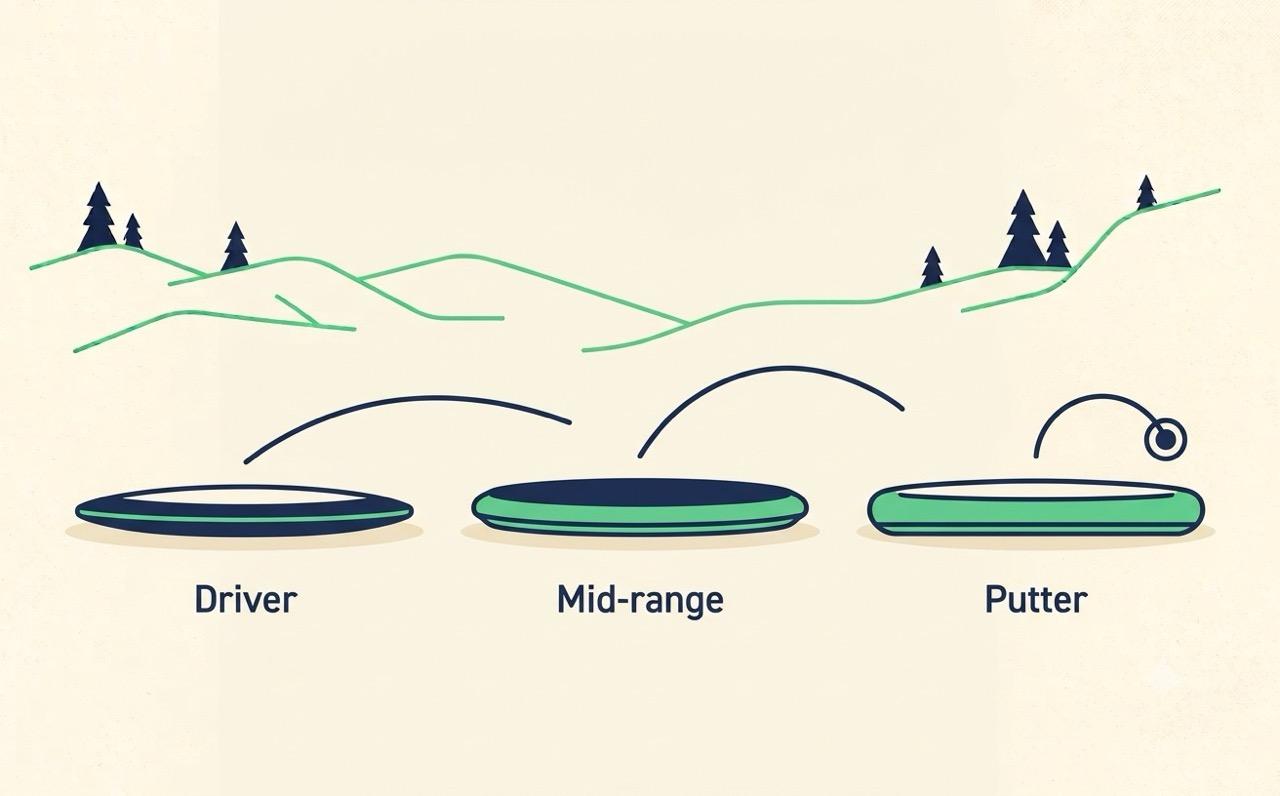
Driver: Innova Leopard3 — Speed 6, and understable by design (it turns gently right before fading back left for a righty backhand). That understable flight is exactly what makes it forgiving: it's much easier to throw a flat, controlled shot with a Leopard3 than with a fast, overstable driver, and it still covers real distance once your form develops. It's one of the most commonly recommended first drivers in the sport for a reason.
Mid-range: Discraft Buzzz — Speed 5, glide 4, and about as close to a "do everything" disc as exists. The Buzzz flies straight and predictably at a wide range of power levels, which makes it useful for controlled fairway shots, approach shots, and even short drives through wooded lines. It's a disc you'll likely still be carrying five years from now.
Putter: Innova Aviar — Speed 2, neutral flight (0 turn, 1 fade). The Aviar is the disc Innova's whole understable/overstable putter lineup is measured against — it just flies straight. Putters double as your short-approach disc early on, so a predictable, no-surprises flight matters more here than anywhere else in the bag.
What about weight?
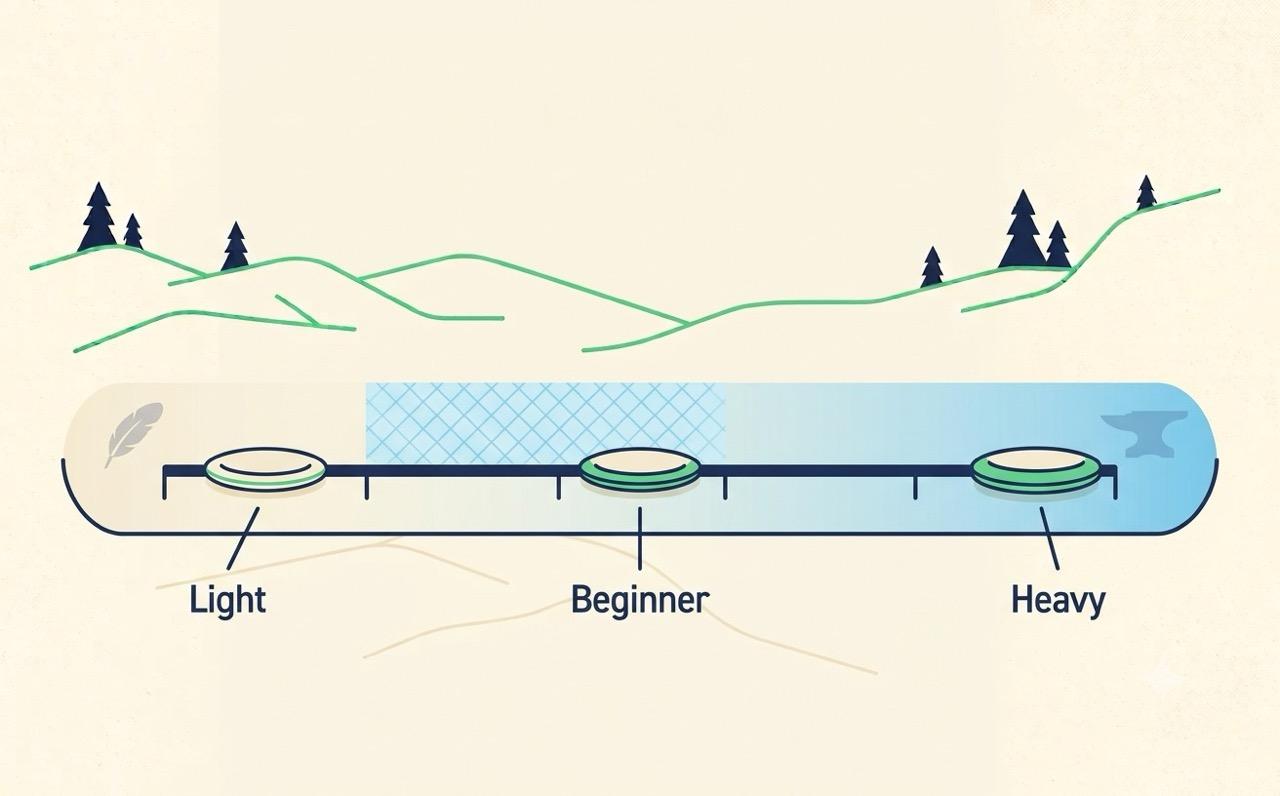
Discs are typically sold between about 150g and 175g. Lighter discs (150g–165g) fly at lower speeds more easily, which is generally friendlier while you're building arm speed and technique — especially for drivers and mid-ranges. For putters, some beginners prefer a bit more weight (170g+) for wind resistance on the green, though it's a smaller factor than with drivers. Don't overthink it for your first set; any weight in the middle of the range is fine to start.
Budget and where to buy
A three-disc starter set like this typically runs $30–$45 total, which is dramatically cheaper than buying a boxed "beginner set" of 8-10 mystery discs that you'll never fully use. Your local disc golf pro shop is a great option if you have one — you can feel the plastic and rim width in your hand before buying — and searching for the exact molds above works fine online too.
Once you've got a season or two on these three discs, you'll have a much better sense of what you actually need next: maybe a more overstable disc for wind, a putter with a bit less fade, or eventually a faster driver once your arm speed catches up. Start small, get consistent flights, and build from there.
For the bag to carry it all in while that collection grows, see our guide to choosing your first disc golf bag.